



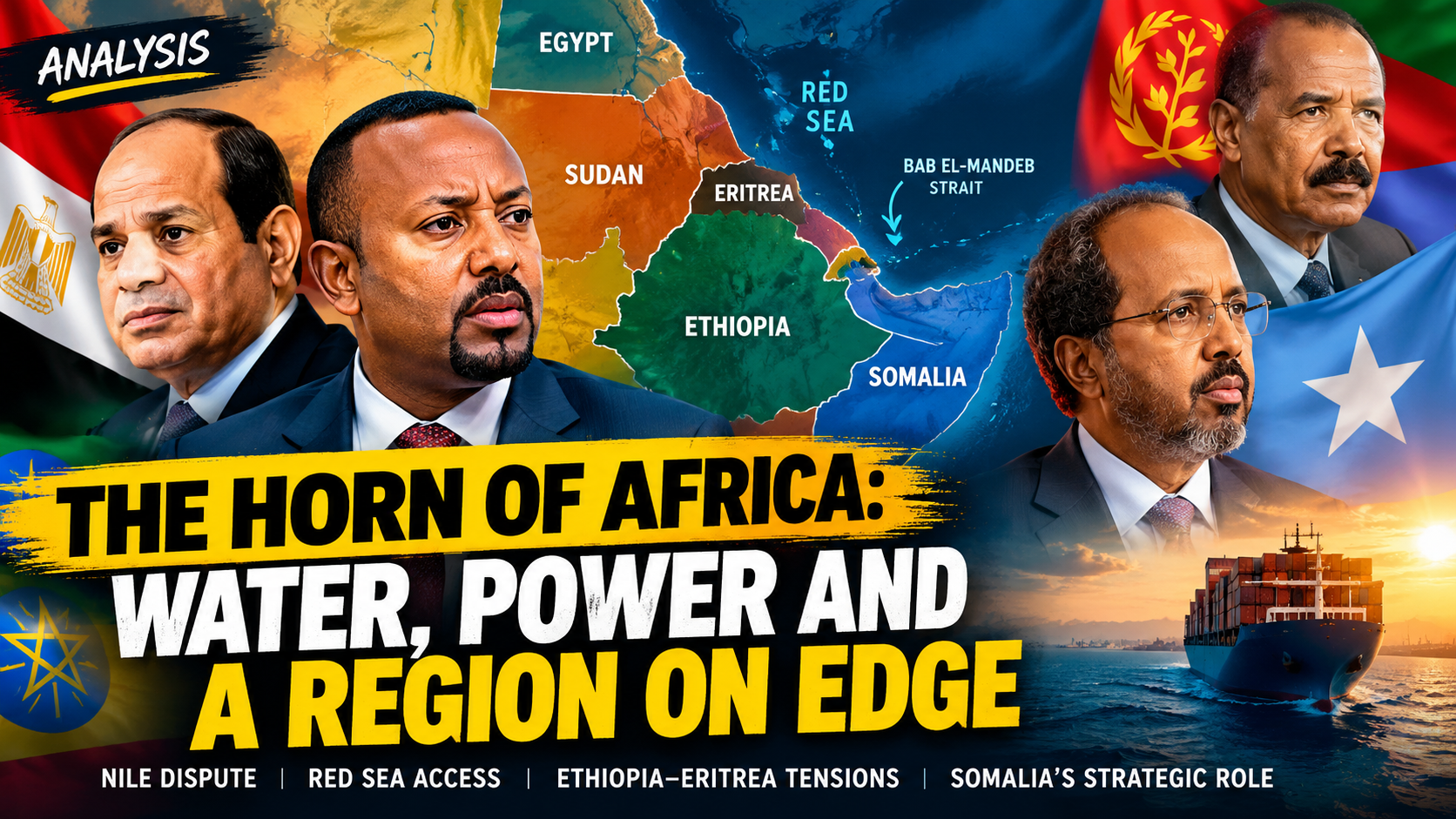
The Horn of Africa is entering another potentially dangerous and transformative period.
On October 4, Egypt brought together the leaders of Somalia, Eritrea and Sudan for a quadrilateral summit in the Egyptian city of New Alamein.
The leaders discussed the security of the Red Sea, the Nile, regional conflicts, sovereignty and territorial integrity.
Just one day later, Ethiopia issued a strongly worded statement of its own.
On Monday, Ethiopia reaffirmed its “legitimate interests” in the Red Sea and its role in the Nile Basin, rejecting political pressure and what it described as “coercive measures” over its regional interests.
In its statement, Ethiopia’s Foreign Ministry said that virtually all of the Blue Nile, or Abay River, originates in the Ethiopian highlands and contributes about 85 percent of the Nile’s total flow.
“Any discussion concerning the utilization and management of the Abay River should be informed by these fundamental realities,” the ministry said.
The statement also highlighted Ethiopia’s historical and geographical ties to the Red Sea. Addis Ababa said the country’s nearest border is about 30 kilometres from the Red Sea coast and argued that regional discussions on maritime affairs and security should recognize what it called its “legitimate interests” and enduring connection to the Red Sea.
This is bigger than a statement about the Blue Nile.
My reading of the statement is that Ethiopia does not want questions surrounding the Nile, the Red Sea and the Horn of Africa’s security architecture to be addressed without taking its interests into account.
The most important point, therefore, may not be the reference to the 85 percent Nile contribution. It is Ethiopia’s insistence that any regional maritime and security architecture must take its interests into account.
This suggests that Addis Ababa increasingly views water security, maritime access and national security as interconnected strategic issues.
Because Egypt, Eritrea, Sudan and Somalia are simultaneously strengthening their consultations, the Horn of Africa is entering a period in which diplomacy will be increasingly important—and miscalculation could have consequences far beyond the original disputes.
The situation is particularly sensitive because Egypt, Eritrea, Somalia and Sudan have demonstrated greater coordination, while Ethiopia is publicly insisting that its interests must be incorporated into any regional arrangement.
So, what exactly is happening? Is this simply diplomatic signaling, or are we witnessing the formation of a new geopolitical alignment around Ethiopia?
1. WHAT DID ETHIOPIA SAY?
Ethiopia’s Ministry of Foreign Affairs has connected two issues that are often discussed separately: the Nile and the Red Sea.
First, Addis Ababa emphasized the importance of the Abay River, or Blue Nile.
According to Ethiopia, virtually all of the Blue Nile originates in the Ethiopian highlands, making the river central to Addis Ababa’s argument over the management of the Nile.
The Ethiopian government argues that any discussion about the utilization and management of the river must recognize this geographical reality.
But Ethiopia did not stop with the Nile.
It also emphasized its historical and geographical connection to the Red Sea, arguing that regional maritime and security discussions must take Ethiopia’s interests into account.
This is strategically important.
This matters because Ethiopia is a landlocked country, and access to international maritime trade is a major economic and strategic concern.
But there is an important distinction here.
Ethiopia’s claim that it has legitimate interests in Red Sea affairs does not automatically mean that it is making a territorial claim to another country’s coastline.
Rather, Addis Ababa appears to be making a broader argument: that Ethiopia’s economic, historical and security interests give it a stake in discussions concerning the Red Sea and the wider regional security architecture.
2. WHY THE TIMING MATTERS
The timing of Ethiopia’s statement is particularly significant.
Just one day earlier, Egypt had hosted the presidents of Somalia and Eritrea, alongside Sudan’s transitional leader, for a quadrilateral summit.
The four countries agreed to strengthen coordination on regional issues and discussed security in the Horn of Africa and the Red Sea.
Their joint declaration emphasized sovereignty, territorial integrity, international law and regional stability.
It also addressed the Nile.
The leaders emphasized the importance of international law in governing transboundary rivers. They called for cooperation, prior notification, consultation and consensus on shared waters, while opposing unilateral measures that could harm the existing water uses of downstream Nile states.
The summit also emphasized the importance of Red Sea security and freedom of navigation through the Gulf of Aden and the Bab el-Mandeb Strait.
And then came Ethiopia’s response.
However, the summit does not necessarily mean that the four countries have formed an anti-Ethiopian military alliance.
Egypt officially described the meeting as a consultative summit focused on regional cooperation and shared challenges.
3. THE NILE: THE OLD DISPUTE
At the heart of the dispute is the Nile.
For Egypt, the Nile is not simply an international river. It is a matter of national security.
For Ethiopia, however, the issue is framed differently.
Ethiopia is an upstream Nile Basin country with substantial development needs and an interest in using its water resources to support economic growth.
The construction and operation of the Grand Ethiopian Renaissance Dam (GERD) turned the disagreement over Nile water management into one of Africa’s most prominent diplomatic disputes.
The disagreement centres on competing concerns.
Ethiopia emphasizes its right to develop its water resources to support electricity generation and economic development. Egypt and Sudan, as downstream countries, have sought assurances that the dam’s filling and operation will not cause significant harm to their water security.
Despite years of negotiations, the countries have struggled to reach a comprehensive agreement.
At its core, this is an upstream–downstream dispute involving water use, development, cooperation and the management of potential risks.
However, another complication has emerged.
The Nile dispute is increasingly connected to the wider security competition in the Horn of Africa.
This brings us to the Red Sea.
4. WHY THE RED SEA CHANGES EVERYTHING
The Red Sea is one of the world’s most strategically important maritime corridors.
It links the Indian Ocean with the Mediterranean through the Bab el-Mandeb Strait and the Suez Canal.
For Ethiopia, however, there is a fundamental problem:
Ethiopia is landlocked.
This means Ethiopia depends on neighbouring countries for access to international ports and maritime trade routes.
Therefore, maritime access is not simply an economic issue for Ethiopia. It is also connected to the country’s long-term economic and strategic interests.
This is why Ethiopia’s repeated references to its historical and geographical connection to the Red Sea deserve attention.
But Ethiopia is not the only country interested in this strategic space.
Look at the map.
You have:
Egypt in the north
Sudan along the western Red Sea.
Eritrea with a long Red Sea coastline.
Djibouti, positioned around an important maritime gateway.
Somalia stretching along the Gulf of Aden and Indian Ocean.
And Ethiopia, the region’s largest landlocked power, sitting immediately behind these coastal states.
5. ERITREA: A CRITICAL VARIABLE
But there is another immediate concern.
Diplomatic relations between Ethiopia and Eritrea have broken down completely.
On October 1, Ethiopia announced the closure of its embassy in Asmara and expelled ten Eritrean diplomats.
Eritrea subsequently announced that it was severing diplomatic relations with Ethiopia.
These developments came as fighting was intensifying in Ethiopia’s northern Tigray region.
Ethiopian federal forces had advanced toward Mekelle, while government forces recaptured the main airport in Tigray’s capital during the recent fighting.
This matters because Ethiopia and Eritrea are not simply neighbors.
They have a history of war.
They also have strategic interests that intersect with the wider Red Sea security environment.
And now, diplomatic relations have deteriorated at a time when fighting has returned to Tigray.
The African Union has urged Ethiopia, Eritrea and Egypt to exercise restraint and avoid actions or rhetoric that could undermine regional peace and stability.
So the immediate danger is not necessarily another Ethiopia–Eritrea war.
The bigger danger is that several separate conflicts could begin reinforcing each other.
Before concluding my analysis of the current Nile and Red Sea situation, I asked myself a question:
What is Ethiopia actually trying to achieve?
My reading of yesterday’s statement is that Addis Ababa is trying to establish three diplomatic principles.
First: “We are an upstream Nile state.”
Ethiopia wants its geographical position as an upstream state to be recognized whenever the Nile is discussed.
Second: “We are a Red Sea stakeholder.
Even without a coastline, Ethiopia argues that its geography, history, economic interests and security concerns give it a legitimate role in discussions about the Red Sea.
Third: “Don’t isolate Ethiopia.
The statement’s references to “proxy actions,” “acts of aggression” and “zero-sum approaches” can be read as a warning against regional arrangements that Ethiopia perceives as attempts to pressure or contain it.
6. SOMALIA’S POSITION
And this brings us to Somalia.
Somalia has an important strategic position in this equation.
Why?
This is because Somalia has a long coastline along the Gulf of Aden and the Indian Ocean.
It is also geographically close to the Bab el-Mandeb Strait and the southern entrance to the Red Sea.
At the same time, Somalia has a complicated relationship with Ethiopia.
Somalia has an interest in maintaining security cooperation with Ethiopia and promoting regional stability.
But Mogadishu also has strong interests in protecting its sovereignty and territorial integrity.
At the same time, Somalia has been deepening its relations with Egypt.
President Hassan Sheikh Mohamud participated in the October 4 quadrilateral summit in Egypt alongside the leaders of Eritrea and Sudan.
Therefore, Somalia is no longer simply observing the competition.
Somalia is increasingly becoming an important actor in the regional balance.
For Mogadishu, the challenge will be to maintain strategic partnerships without becoming drawn into a larger confrontation between Ethiopia and its regional rivals.
That will require careful diplomacy.
7. THREE POSSIBLE SCENARIOS
Based on these developments, I see three possible scenarios for the region.
Scenario One: Diplomatic Containment
The first, and arguably the most constructive, scenario is diplomatic containment.
Regional governments may recognize the risks of further escalation and return to serious diplomatic engagement. Egypt and Ethiopia could resume meaningful negotiations over the Nile, while Ethiopia and Eritrea could seek ways to reopen diplomatic channels. Somalia, Sudan, and other regional actors could encourage dialogue and support mechanisms that protect their respective interests without allowing existing disputes to develop into a wider regional crisis.
This scenario would not require the countries to abandon their strategic interests. Instead, it would require them to manage those interests through negotiation, consultation, and regional diplomacy.
Scenario Two: Intensifying Regional Competition
The second scenario is a prolonged period of regional competition.
Under this scenario, tensions may not develop into direct military confrontation, but rivalry and competition for regional influence could increase. Egypt could strengthen its relations with Somalia and other regional partners, while Ethiopia could deepen its relationships with other African and international partners.
The result could be greater competition over political influence, security partnerships, maritime access, and regional alliances. In that sense, the Horn of Africa could experience a form of strategic competition resembling a Cold War-style rivalry, without necessarily developing into a conventional war.
Scenario Three: Interconnected Conflicts
The third, and most serious, scenario would be the interaction of several existing conflicts and disputes.
If fighting in Tigray continues, tensions between Ethiopia and Eritrea increase, the Nile dispute becomes more confrontational, and the conflict in Sudan remains unresolved, these developments could begin to reinforce one another. Greater involvement by regional powers could further complicate the situation.
The danger is that a conflict or diplomatic crisis in one part of the region could trigger political, security, or economic reactions elsewhere. In such a situation, disputes that currently appear separate could become increasingly interconnected.
This is why regional and international mediators have an important role to play in preventing individual disputes from developing into a broader regional crisis.
CONCLUSION: WHAT DOES THIS MEAN FOR THE HORN OF AFRICA?
The key point is that this is no longer just a dispute over the Blue Nile. Ethiopia is increasingly presenting its interests in the Nile, Red Sea access, maritime connectivity, and national security as interconnected issues.
At the same time, Egypt is strengthening consultations with Somalia, Eritrea, and Sudan on regional security, the Nile, and Red Sea navigation. Meanwhile, relations between Ethiopia and Eritrea have deteriorated sharply, while renewed fighting in Tigray raises further concerns about regional stability.
These developments do not necessarily mean that a wider regional conflict is inevitable. However, they show how disputes over water, maritime access, territorial integrity, and political influence could interact and make an already complex regional situation more difficult to manage.
For Somalia, the priority should be to protect its sovereignty and territorial integrity, maintain its freedom to pursue independent diplomatic relationships, and use its strategic position to contribute to regional stability rather than become drawn into escalating rivalries.
Ultimately, the security of the Horn of Africa cannot be achieved by ignoring the legitimate concerns of neighboring countries or by treating every regional dispute as a zero-sum competition. It requires sustained dialogue, respect for international law, and diplomatic efforts to prevent disagreements from turning into wider confrontations.
The question is not simply who gains influence over the Nile or the Red Sea. It is whether the countries of the region can manage their competing interests without creating a crisis that affects them all.
I’m Mohamed, and this is my analysis of the changing geopolitics of the Horn of Africa.